
When people search for CSE title case, defined by the Council of Scientific Editors for biology journals, they often expect headline-style caps. Biology journals usually want something calmer, sentence case for the paper title, with scientific terms kept in their standard form.
That difference trips up students, researchers, and scientific editors all the time. Mastering these capitalization rules is a key part of professional CSE referencing. A title can look polished and still be wrong if every major word is capitalized. The fix is simple once you know which words CSE leaves alone, and which ones must keep their scientific casing.
Key Takeaways
- CSE title case for biology paper titles uses sentence case, capitalizing the first word, proper nouns, and standard scientific terms like gene symbols or acronyms, while leaving most words lowercase.
- Preserve scientific notation: italicize Latin binomials with genus capitalized and species lowercase (e.g., Danio rerio), keep acronyms uppercase (e.g., CRISPR, GFP), and maintain gene name casing.
- Journal titles retain their standard capitalization or abbreviation, unlike article titles which stay in sentence case.
- Check the target journal's author instructions and recent papers, as house styles may vary slightly on subtitles or other details.
- Avoid headline-style capitalization from styles like APA to prevent common errors in CSE-formatted bibliographies.
The main CSE rule biology authors need
For biology paper titles, CSE usually does not use headline-style title case for article titles. In most CSE-formatted bibliography entries across the life and physical sciences, article and book chapter titles appear in sentence case. That means you capitalize the first word, proper nouns like gene symbols, and any term that has its own fixed form, such as an acronym. The formal source is the CSE Manual Online.
In most CSE-based biology writing, the article title is capped like a sentence, not like a newspaper headline.
So, "Effects of salinity on larval growth in Danio rerio" fits CSE much better than "Effects of Salinity on Larval Growth in Danio rerio". The first version looks less dramatic, but it's the safer default.
A common source of confusion is the gap between article titles and journal titles. The paper title usually stays in sentence case, while journal titles retain their standard capitalization or abbreviation. "Journal of Experimental Biology" stays capitalized. The article inside it usually does not.
If you're used to other style guides, the contrast is sharp. A quick look at APA 7th edition title case rules shows how easily writers carry headline habits into CSE work.
Whether a journal uses name-year, citation-sequence, or citation-name usually doesn't change the title's capitalization pattern. Metadata such as author names, publication date, volume number, issue number, page range, and a DOI or ISSN abbreviation remains standard across these systems. Still, house style can vary. Many biology journals follow CSE principles but tweak details, so the safest move is to check the journal's author instructions and copy the capitalization pattern from recent papers.
Correct and incorrect CSE capitalization examples
Examples make this rule easier to trust. The table below shows key CSE capitalization rules in action for biology titles.
| Incorrect | Correct | Why |
|---|---|---|
| Effects of Salinity on Larval Growth in Danio rerio | Effects of salinity on larval growth in Danio rerio | Only the first word starts with a capital; genus stays capped, species stays lowercase. |
| CRISPR Editing Improves Drought Tolerance in Rice | CRISPR editing improves drought tolerance in rice | Acronyms stay uppercase, but regular words stay lowercase unless they open the title. |
| Gene Expression in Escherichia Coli under Heat Stress | Gene expression in Escherichia coli under heat stress | In Latin binomials, capitalize the genus only. |
| Microbiome Shifts in HIV-1 Positive Adults after Treatment | Microbiome shifts in HIV-1-positive adults after treatment | Keep the acronym's standard form and keep the hyphenated adjective lowercase mid-title. |
| Expression of LacZ and Gfp in E. coli Biofilms | Expression of lacZ and GFP in E. coli biofilms | Preserve official scientific casing rather than forcing title-style caps. |
The pattern is plain once you see it. CSE doesn't reward you for capitalizing every "important" word. It asks you to respect standard language plus standard scientific notation. These capitalization rules also apply to bibliography entries for various article types, capitalizing the first word only except for proper nouns and scientific terms; note that journal titles used in citations differ from the article titles they contain and often follow title case.
This is where short words cause trouble. Articles, prepositions, and conjunctions usually stay lowercase because the whole title stays close to sentence case. If you want a quick contrast with headline capitalization, these title case rules for articles a an the show why CSE looks restrained by comparison. For a quick CSE reference sheet, IRSC's guide to titles lays out the same basic pattern.
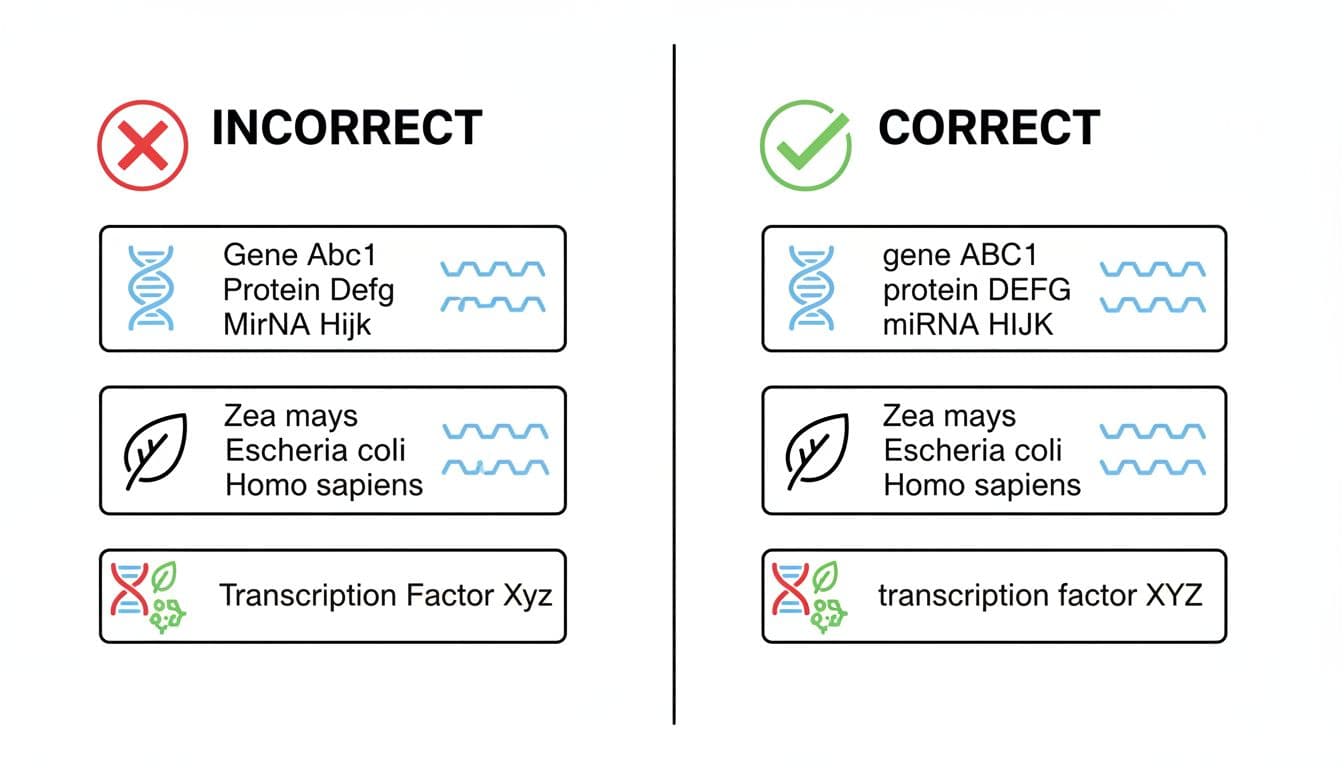
Edge cases that cause trouble in biology titles
Biology titles carry extra baggage, because scientific names and symbols have rules of their own. If you force them into generic title case, you can change the meaning.
Latin binomials come first. Write Arabidopsis thaliana, Drosophila melanogaster, and Escherichia coli with the genus capitalized and the species lowercase. Both are usually italicized. The Valdosta State biology CSE quick guide uses the same treatment in its examples.
acronyms keep their standard form Don't recase them to fit a title pattern. The same rule applies to gene and protein names. Preserve official casing and italics from your discipline or target journal.
Hyphenated words need a careful read. In CSE-style biology titles, you don't capitalize both sides because of headline logic. Write "long-term exposure," "heat-shock response," or "HIV-1-positive adults" unless one part begins the whole title or is a proper noun.
Subtitles deserve special attention. Many CSE-based guides keep the subtitle in sentence case after a colon, as in "Pollinator behavior in alpine meadows: effects of snowmelt timing on nectar traits." Some journals capitalize the first subtitle word. Because practice varies here, check the journal's own examples before you lock it in.
Citing technical reports and online books brings more challenges. Sentence case still applies to the document title. Include author names, handling any secondary author with the standard CSE format (initials after the first), along with publisher information and the name of a sponsoring organization for reports. This keeps citations clear without altering title capitalization.
Writers also mix up CSE with general title-case tools. If you're comparing styles, these preposition rules in different style guides show how far CSE can drift from APA, AP, or Chicago habits.
Frequently Asked Questions
What is the main rule for CSE title case in biology papers?
CSE uses sentence case for article and book chapter titles in biology bibliographies, capitalizing only the first word, proper nouns, and terms with fixed scientific forms like acronyms or gene symbols. This contrasts with headline-style capitalization seen in other guides. Journal titles, however, keep their standard capitalization.
How should scientific names be handled in CSE titles?
In Latin binomials, capitalize and italicize the genus (e.g., Escherichia) but keep the species lowercase (e.g., coli). Gene and protein names preserve their official casing and italics from the discipline. Forcing title case can alter meaning, so always respect standard notation.
Do acronyms and abbreviations change capitalization in CSE titles?
No, keep acronyms like DNA, PCR, HIV-1, or GFP in their standard uppercase form, even mid-title. The same applies to abbreviations like E. coli. CSE prioritizes scientific clarity over title-style rules.
What's the difference between article titles and journal titles in CSE?
Article titles use sentence case, while journal titles retain their conventional capitalization (e.g., Journal of Experimental Biology) or standard abbreviation. This distinction holds across CSE systems like name-year or citation-sequence. Always copy patterns from the journal's recent papers.
Are there special rules for subtitles or hyphenated words in CSE biology titles?
Subtitles after a colon usually follow sentence case, though some journals capitalize the first word, check instructions. Hyphenated terms like 'HIV-1-positive' or 'heat-shock' stay lowercase mid-title unless starting it. Practice varies, so mimic the journal's examples.
The Bottom Line
The safest takeaway is simple: for biology paper titles, CSE title case usually means sentence case plus correct scientific notation. Capitalize the first word, keep proper names and acronyms in their standard form, and leave the rest alone.
CSE referencing involves more than just titles. The reference list is organized in alphabetical order for the name-year system, while in-text citations in the citation-sequence and citation-name styles often use superscript numbers. Most title errors happen when writers import headline habits from other guides. If you preserve species names, gene symbols, hyphenated compounds, and the journal's own subtitle pattern, your title will look right the first time. Ultimately, CSE title case ensures scientific clarity across all bibliography entries.