

Tiny words cause big hesitation in title capitalization. When people search is but capitalized, they usually want a quick answer they can trust from the Associated Press Stylebook, the Chicago Manual of Style, and APA style, which have largely consistent rules for this word.
Here it is: “but” is usually lowercase in the middle of a title. It stays lowercase because it is a coordinating conjunction but. The main exceptions are simple: capitalize it when it is the first or last word of the title (or subtitle).
The fast answer on “but” in title case
“But” is a coordinating conjunction. That means it joins two equal parts, like small but strong or funny but true. In title case formatting, style guides often treat short conjunctions like “but” as minor words, so they stay lowercase unless they are the first word or last word. This contrasts with sentence case, where only the first word of a title gets capitalized.
Here’s the pattern most writers need:
- Correct: Lost but Not Forgotten (middle position)
- Incorrect: Lost But Not Forgotten
- Correct: But for One Mistake (first word)
- Correct: Nothing But (last word)
If “but” sits in the middle of a title, keep it lowercase in AP, Chicago, APA, and the MLA Handbook.
That shared answer surprises people because these style guides do differ in other places. Still, for but, the result is the same most of the time in title case.
AP Style vs Chicago Manual of Style vs APA Style at a glance
The details are easier to see side by side.
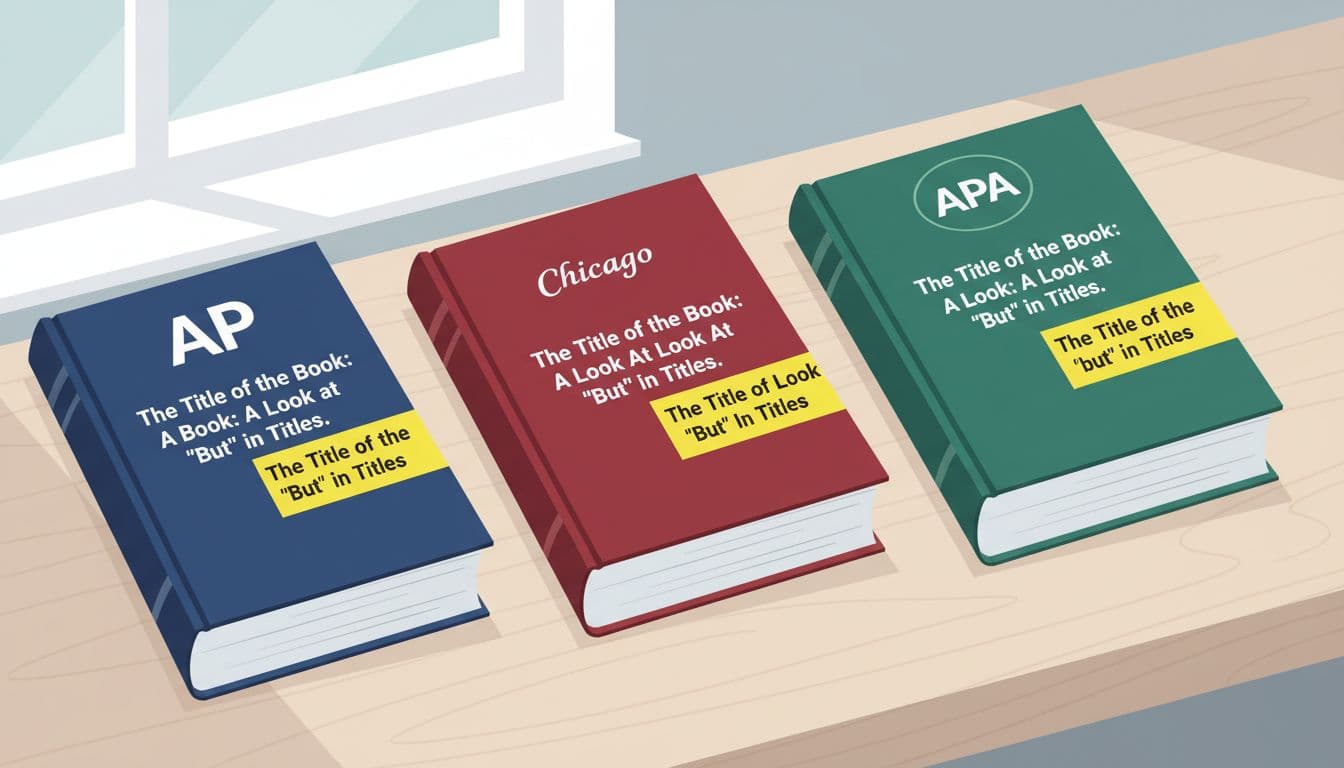
| Style guide | “But” in the middle of a title | Correct example | Short reason |
|---|---|---|---|
| AP style | Lowercase | Lost but Not Forgotten | AP style treats “but” as a short coordinating conjunction |
| Chicago Manual of Style | Lowercase | Lost but Not Forgotten | Chicago Manual of Style lowercases coordinating conjunctions |
| APA style | Lowercase | Lost but Not Forgotten | APA style lowercases short conjunctions like “but” |
So, the practical answer is easy: Most style guides agree to keep “but” lowercase in the middle because it is not one of the major words, like nouns and pronouns.
Where style guides start to split is with other short words. APA style, for example, capitalizes many four-letter prepositions that the Chicago Manual of Style may lowercase. That’s why titles like With or From can trip people up, especially with short prepositions. These differences often come down to headline style preferences. If that’s the part that slows you down, this guide to title case prepositions helps sort out those differences.
For a broader word-by-word reference, Words to Capitalize in a Title is useful when you hit a strange edge case.
Why “but” usually stays lowercase
The simplest way to remember this rule is to think of “but” as a small bridge word. Its grammatical function determines how to capitalize titles: major words like nouns, adjectives, and verbs get capitalized, while minor words such as articles, short prepositions, and conjunctions stay lowercase in the middle. Because of that, title case systems tend to leave it lowercase when it plays that supporting role.
For example, in Smart but Risky and Close but No Prize, the important meaning sits in the nouns, adjectives, and verbs. “But” just links them like a preposition or conjunction.

Position matters, though. If “but” starts the title, it gets a capital because every style capitalizes the first word. The same goes for the last word.
That gives you three easy checks:
- Middle of the title, lowercase it.
- First word, capitalize it.
- Last word, capitalize it.
There are rare cases where “but” acts as something other than a conjunction or preposition. For instance, “but as an adverb” is an exception to standard capitalization rules; an adverb like this might get capitalized as a major word. Grammar and punctuation rules also apply if “but” is part of a hyphenated compound, such as “not-but-yes.” Even the New York Times style can treat an adverb form of “but” differently in some contexts.

